
Why do some drones use one large motor, while others use multiple small motor?The answer depends on the mission requirements and the UAV motor solutions behind different designs.
Single-rotor drones rely on a high-power motor to drive the main rotor, improving payload capacity and flight endurance. Multirotor drones use multiple independent motors to control propellers, enabling more flexible attitude control.
Different UAV motor solutions focus on balancing efficiency, control capability, and reliability.
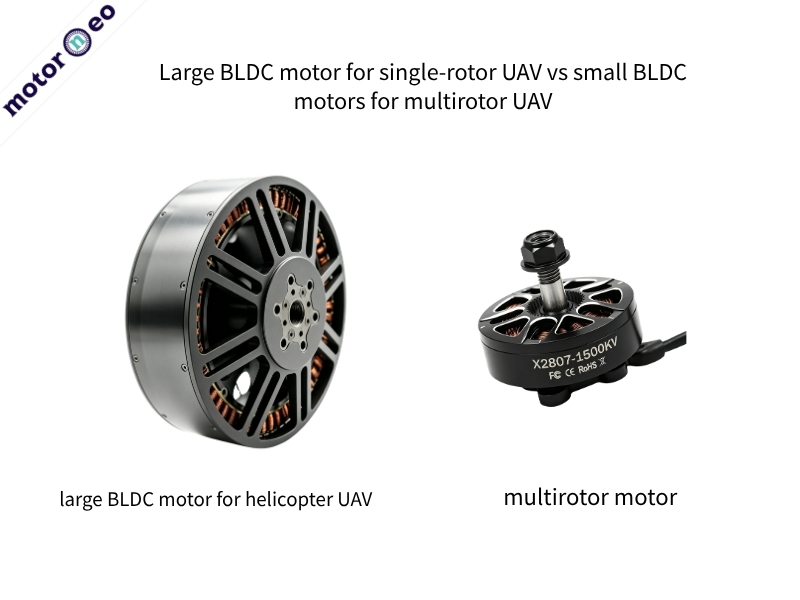
Why Do Single-Rotor UAVs Use Large Motors?
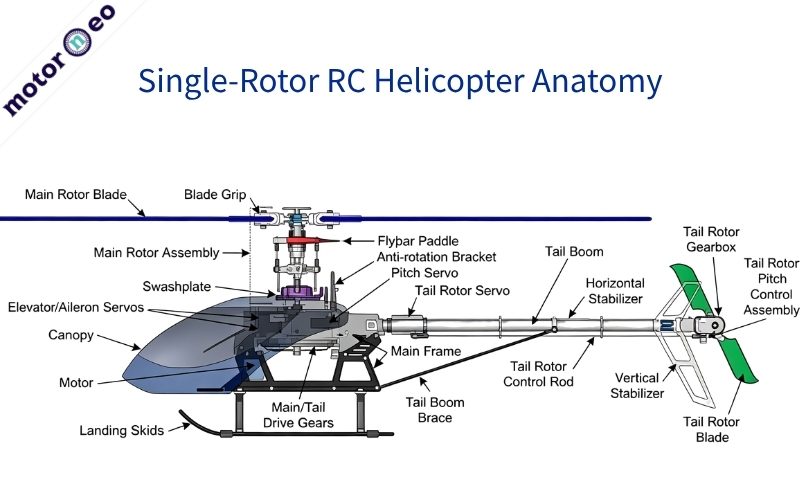
The structure of a single-rotor drone is very similar to a traditional helicopter.
It usually includes:
- A main rotor;
- A high-power motor;
- A tail rotor or another anti-torque mechanism.
After the motor generates power, it drives the large rotor to spin and produce lift.
The biggest advantage of this structure is its high rotor efficiency.
The reason is that a larger rotor has a larger rotor disk area. It can generate the same amount of lift with lower airflow speed, which reduces energy loss and improves hovering efficiency.
This is why helicopters can hover for long periods and carry heavy loads.
For some industrial applications, such as agricultural operations, forest inspection, and heavy-load transport, single-rotor drones still have clear advantages.
For example, some industrial unmanned helicopters are used for logistics, equipment inspection, and special operations. They use a helicopter-like single-rotor structure. The large rotor provides stable lift, allowing the drone to hover for extended periods and carry heavier payloads.
These applications do not focus on the fastest response. Instead, they prioritize payload capacity and flight efficiency per unit of energy consumption.
Compared with multirotor drones, single-rotor drones can usually use larger rotors, providing higher thrust output with better energy efficiency.
Why Aren’t All Drones Single-Rotor?
If single-rotor drones are more efficient, why don’t camera drones like the DJI Mini use this design?
The biggest challenge is that single-rotor drones are much more complex to control.
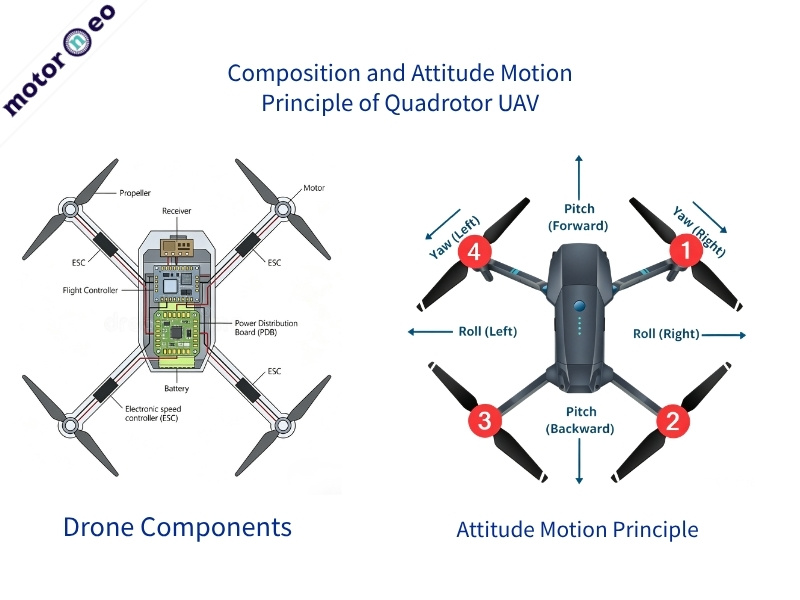
Multirotor drones adjust their attitude in a much simpler way:
They change the speed of different motors.
For example, when a quadcopter flies forward, it only needs to increase the rear motor speed and reduce the front motor speed. This tilts the drone forward and creates forward movement.
A single-rotor drone cannot achieve these movements by simply changing motor speed.
It usually requires:
- Changing the main rotor pitch;
- Adjusting the rotor angle;
- Using a tail rotor to control direction.
These mechanical systems allow complex flight control, but they also increase design complexity and maintenance costs.
Therefore, although single-rotor drones offer higher efficiency, they are more suitable for professional applications rather than consumer drones that prioritize simple operation.
Multirotor UAV Motor Solutions: Why Use Multiple Motors?
Compared with single-rotor drones, multirotor drones adopt a completely different design approach.
Instead of relying on complex mechanical systems for flight control, they use independent motors for each propeller.
Take a quadcopter as an example:
- 4 brushless motors;
- 4 ESCs (Electronic Speed Controllers);
- 1 flight control system.
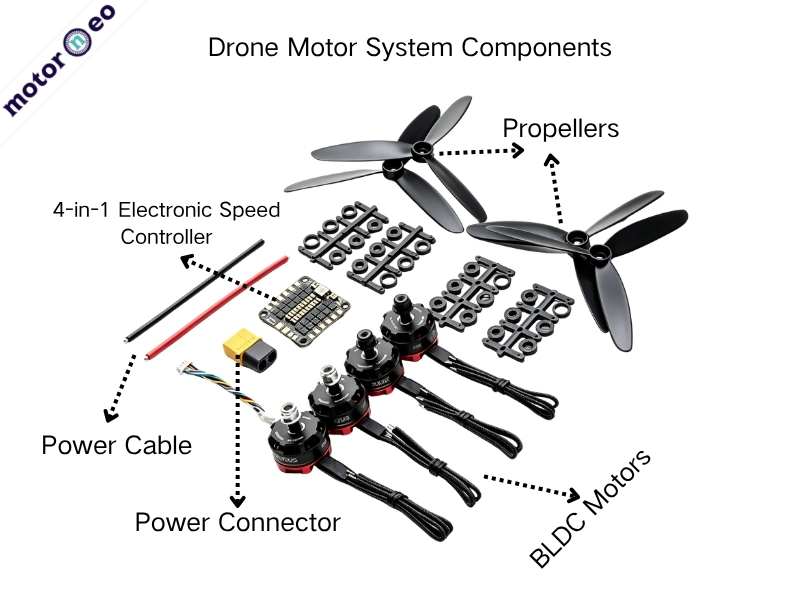
The flight controller adjusts the speed of each motor in real time to control altitude, direction, and attitude.
For example, when a quadcopter needs to move forward, the rear motors increase speed while the front motors reduce output. This tilts the drone forward and creates forward movement.
The entire process does not require complex mechanical transmission systems.
This is the biggest advantage of multirotor drones: using electronic control instead of mechanical control.
With the development of brushless motors, sensors, and flight control algorithms, multirotor drones can achieve highly accurate hovering and attitude control.
This is why:
- Aerial photography drones;
- Mapping drones;
- Consumer drones;
mostly adopt multirotor designs.
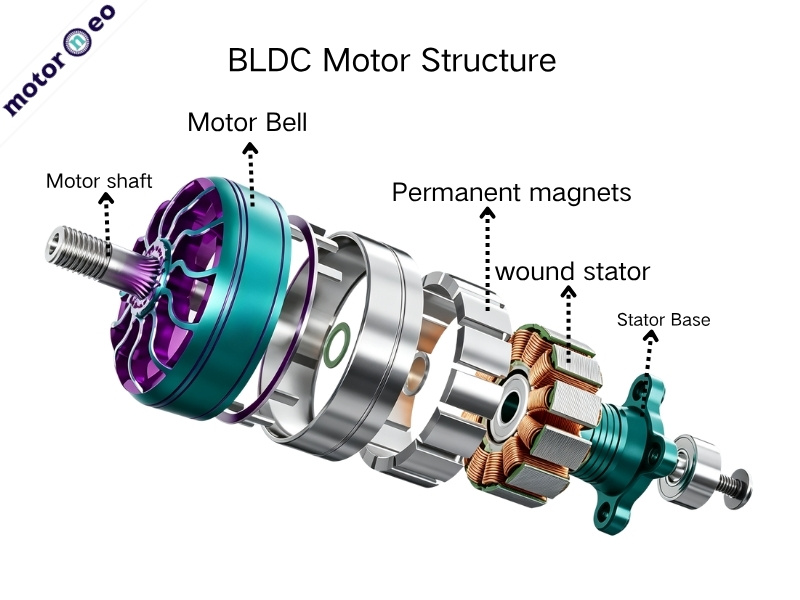
Although multirotor drones use multiple small motors, these motors are not simply low-power products.
To meet the requirements for weight and thrust, multirotor motors usually adopt an outrunner BLDC motor structure. Compared with traditional inrunner motors, outrunner designs can provide higher torque output and are better suited for large-diameter, low-speed propellers.
Motor design needs to consider several factors:
- Stator size;
- Winding design;
- Magnet arrangement;
- Cooling capability;
- Power density.
For heavy-lift applications such as agricultural drones, motors need not only high power output but also stable operation over long periods.
Multirotor Advantages: Control and Redundancy
One of the biggest advantages of multirotor drones is their flexible control.
Each motor works as an independent power unit.
The flight controller can adjust the output of each motor in real time based on:
- Wind conditions;
- Flight attitude;
- Payload changes.
This capability is especially important for tasks that require stable hovering.
For example, aerial photography drones need stable flight to keep the camera steady, while agricultural drones need to maintain a fixed altitude during spraying operations. Both rely on the fast coordination of multiple motors.
Another advantage is power redundancy.
Single-rotor drones rely on one main power source, while hexacopters and octocopters have multiple independent power units.
If one motor fails, the other motors can still provide partial thrust support.
Of course, whether the drone can continue flying depends on several factors, including:
- Remaining thrust;
- Payload weight;
- Flight control strategy;
- Overall system design.
However, compared with a single-power-source system, a multi-motor design provides a higher safety margin.
Why Are Agricultural Drones Multirotors?
Agricultural drones are one of the most important applications of multirotor technology.
Compared with aerial photography drones, agricultural drones face completely different challenges.
They need to:
- Carry tens of kilograms of liquid or fertilizer;
- Fly at low altitude for long periods;
- Precisely control spraying paths.
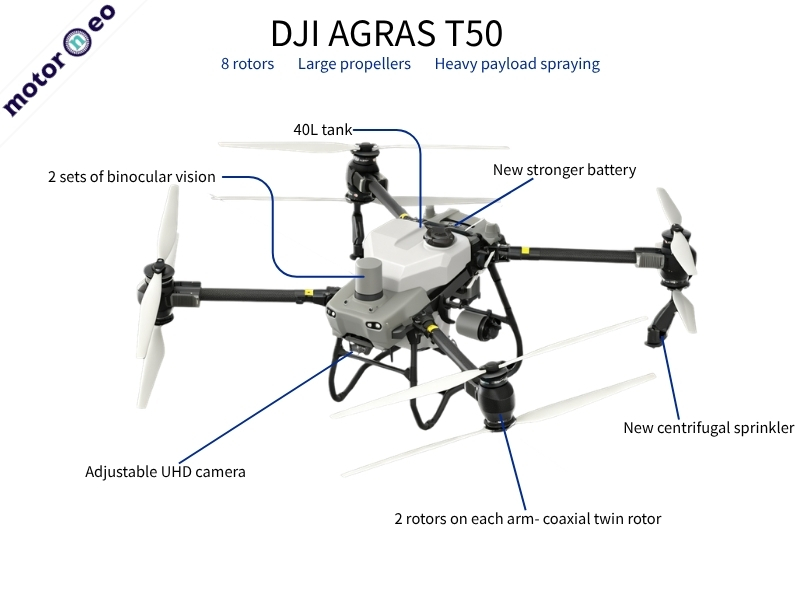
For example, the DJI AGRAS T50 features:
- An octocopter design;
- 54-inch propellers;
- Around 4,000 W power per motor;
- A maximum spraying payload of about 40 kg;
- A maximum spreading payload of about 50 kg.
For these applications, hovering capability and precise control are more important than maximum flight speed.
Therefore, multirotor propulsion systems have become the mainstream choice for agricultural drones.
Why Do Fixed-Wing UAVs Choose Different Motors?
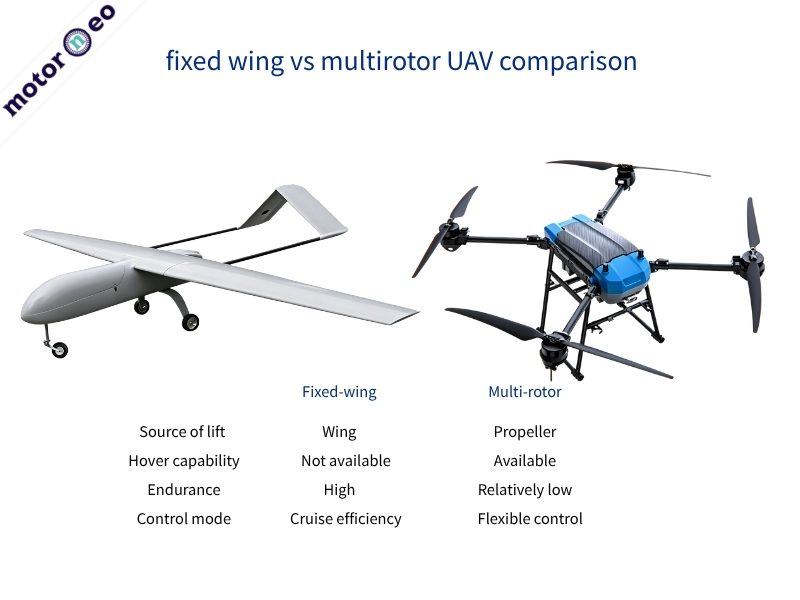
Fixed-wing drones generate lift through their wings, while the motor mainly provides forward propulsion. Therefore, compared with multirotor drones, they offer higher energy efficiency and longer flight endurance.
However, fixed-wing drones cannot hover. This makes them more suitable for large-area mapping, environmental monitoring, and long-distance inspections, but less suitable for low-altitude precision operations.
Therefore, fixed-wing and multirotor drones are not competitors. They are designed for different mission requirements.
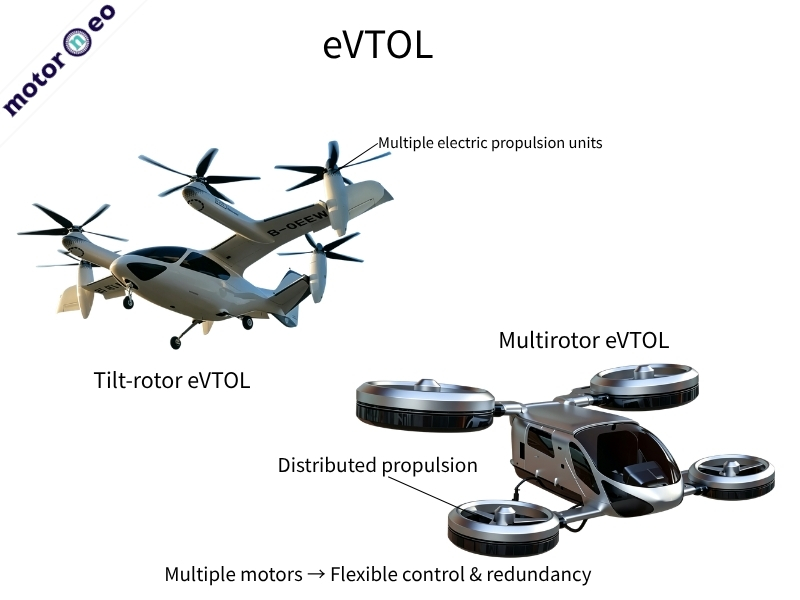
Why Does eVTOL Use Distributed Propulsion?
In recent years, eVTOL (electric vertical takeoff and landing aircraft) has become an important direction in aviation electrification.
Compared with traditional engines, electric motors are easier to integrate into modular propulsion systems.
Therefore, some eVTOL designs use multiple electric propulsion units. Through distributed propulsion, they can achieve:
- More flexible layouts;
- Higher reliability;
- Better control capability
By combining the vertical takeoff and landing capability of multirotor drones with the cruising efficiency of fixed-wing aircraft, eVTOL represents an important area of exploration for the future of aviation.
Future UAV Motor Trends
Single-rotor, multirotor, and fixed-wing drones do not have absolute advantages or disadvantages.
Single-rotor drones rely on large rotor efficiency, making them more suitable for heavy payloads and long-duration missions. Multirotor drones use multiple independent motors, making them better suited for hovering, precise control, and complex operating environments.
For motor manufacturers, the real challenge of UAV motor solutions is not simply increasing power output. It is finding the best balance between weight, efficiency, cooling performance, and reliability.
Will future drones continue to use more small motors, or will they explore larger propulsion systems with higher power density?
Looking for stator and rotor core solutions? Motorneo can support custom designs based on your drawings and provide selected standard tooling options for specific applications. Contact us for your project.