
Most traditional traction motors look like cylinders. The YASA axial flux motor looks more like a flat disc.
But how much difference can this shape really make?
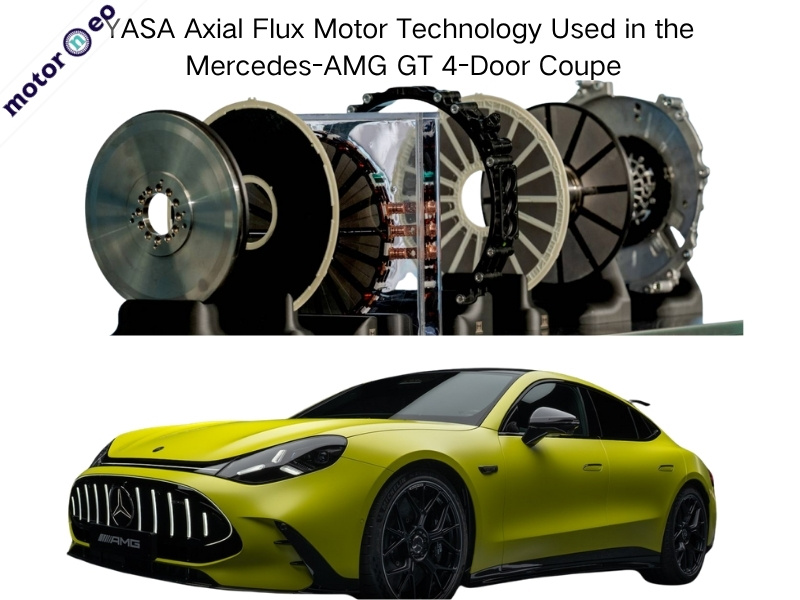
In June 2026, Mercedes-Benz started large-scale production of its next-generation axial flux motor in Berlin-Marienfelde. The motor will first appear in the new Mercedes-AMG GT 4-Door Coupe. This marks an important change. Axial flux technology is no longer limited to prototypes and low-volume supercars.
The real question is therefore no longer simply, “Can an axial flux motor work?”
It is:How can such a thin motor deliver high power, and can manufacturers build thousands of them consistently?
What Is the Biggest Difference Between Axial and Radial Flux Motors?
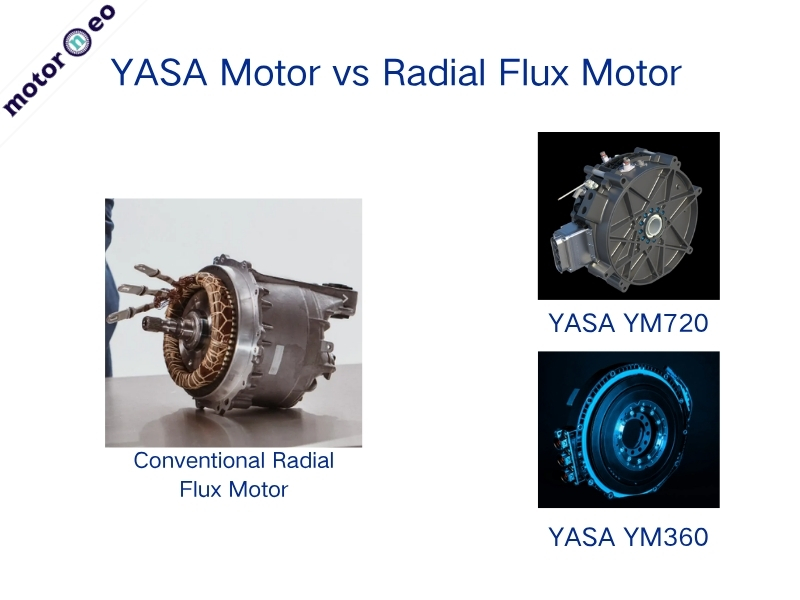
In a common inner-rotor radial flux motor, the stator surrounds the rotor. Magnetic flux crosses the air gap mainly in the radial direction.
This naturally creates a cylindrical motor. Designers can increase the active axial length when they need more electromagnetic working area.
An axial flux motor arranges its main components more like stacked discs. Magnetic flux crosses the air gap along the motor axis. Mercedes-Benz uses a dual-rotor, single-stator layout. Two rotor discs sandwich the stator from both sides.
Simply put:
A radial flux motor resembles a thermos. An axial flux motor resembles a flying disc.
The difference is more than appearance. It changes how the motor uses space, produces torque, and removes heat.
Why Is the YASA Axial Flux Motor So Thin?
A Larger Effective Torque Radius
Torque depends on force and the radius where that force acts.
Think about tightening a bolt with a wrench. Apply the same force farther from the bolt, and you create more torque.
An axial flux motor can place more electromagnetic interaction at a relatively large effective radius. This helps generate high torque without requiring a long cylindrical motor.
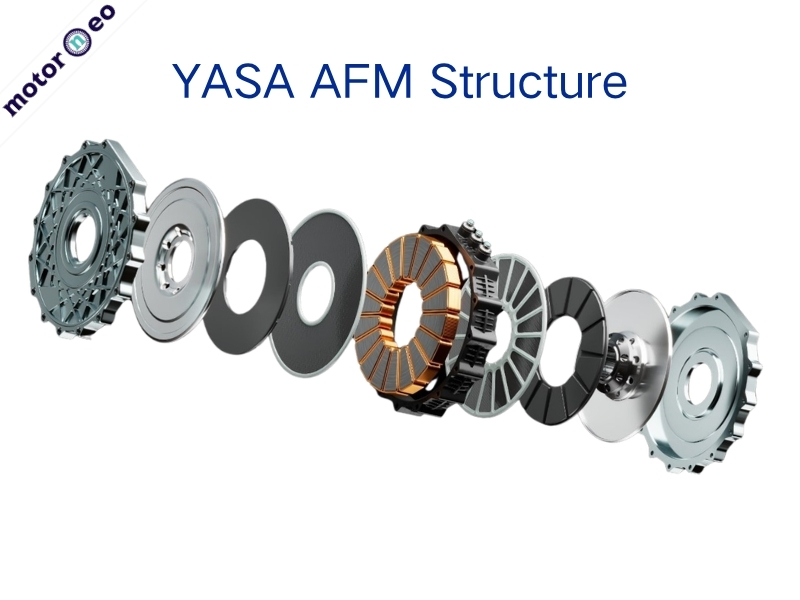
YASA combines this geometry with short copper windings. The company says this contributes to significantly higher torque density than conventional electric motor designs.
But geometry is only part of the story.
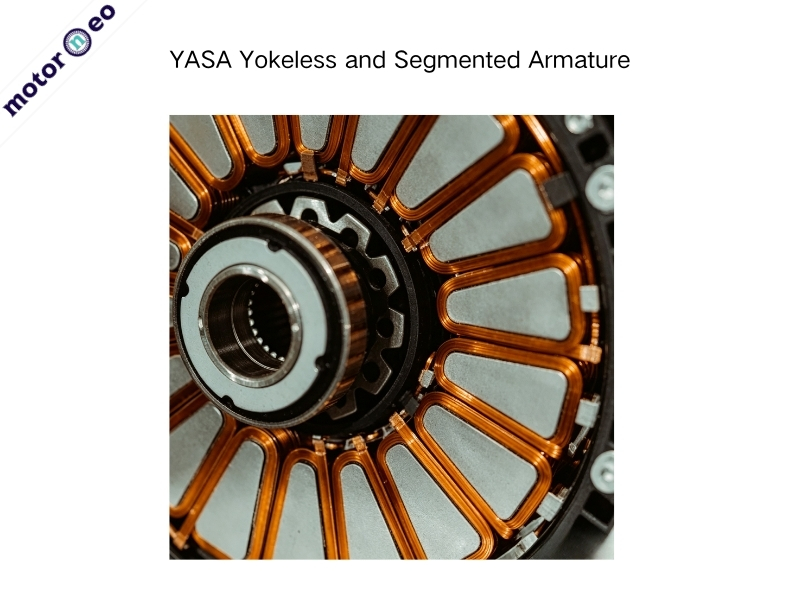
YASA Removes the Conventional Stator Yoke.YASA means Yokeless And Segmented Armature.
In many conventional stators, a continuous iron yoke connects the stator teeth. YASA removes this traditional continuous yoke and divides the armature into separate pole units.
Why does that matter?
Less yoke means less inactive iron. YASA states that its topology can reduce stator iron mass by as much as 80%. The company also reports two to three times the power density of non-axial machines.
YASA also claims roughly 50% lower motor volume and 50% lower weight than comparable radial solutions. These are manufacturer-reported comparisons, so actual results depend on the motor design and application.
Those percentages sound impressive. But actual motor specifications make the difference easier to understand.
What Do Real YASA Motors Deliver?
YASA currently offers the YM360 and YM720 for applications in the 400–800 V range. Their specifications give a more practical view of axial flux performance.
| Specification | YASA YM360 | YASA YM720 |
| Peak power | 125 kW | 350 kW |
| Peak torque | 360 N·m | 700 N·m |
| Continuous power | 58 kW | 180 kW |
| Continuous torque | 108 N·m | 350 N·m |
| Maximum speed | 9,000 rpm | 10,000 rpm |
| Mass | 24 kg | 33 kg |
| Size | 305 × 107 mm | 345 × 123 mm |
| Cooling | Dielectric oil | Dielectric oil |
These figures show why “thin” matters.
The YM720 produces 350 kW peak power and 700 N·m peak torque from a package only 123 mm deep.
YASA has pushed the concept much further in prototypes.
In October 2025, the company tested a 12.7 kg prototype at 750 kW short-term peak power. That equals an unofficial 59 kW/kg peak power density. YASA estimated continuous power at around 350–400 kW. This is still prototype data, not a production rating.
That distinction matters. A record prototype proves what the architecture can potentially achieve. It does not prove that the same motor can meet automotive cost, durability, and production targets.
And that brings us to the real reason YASA is interesting today.
Why Are Axial Flux Motors Well Suited to High-Performance Cars?
Sports cars have a packaging problem.
The powertrain must contain motors, inverters, gearboxes, cooling systems, batteries, and suspension components. Hybrids must also fit an engine and transmission.
Saving even several centimeters can therefore change the entire powertrain layout.
Ferrari SF90 Stradale
Ferrari placed a custom YASA motor between the engine and gearbox in the SF90 Stradale.
YASA reported a power density of 14 kW/kg for this custom motor when the project launched. The rear axial flux motor forms part of a three-motor hybrid system.
This is an ideal example of why axial length matters.
A conventional long cylindrical motor would compete for space with the engine and transmission. A flat motor fits naturally between them.
Lamborghini Revuelto
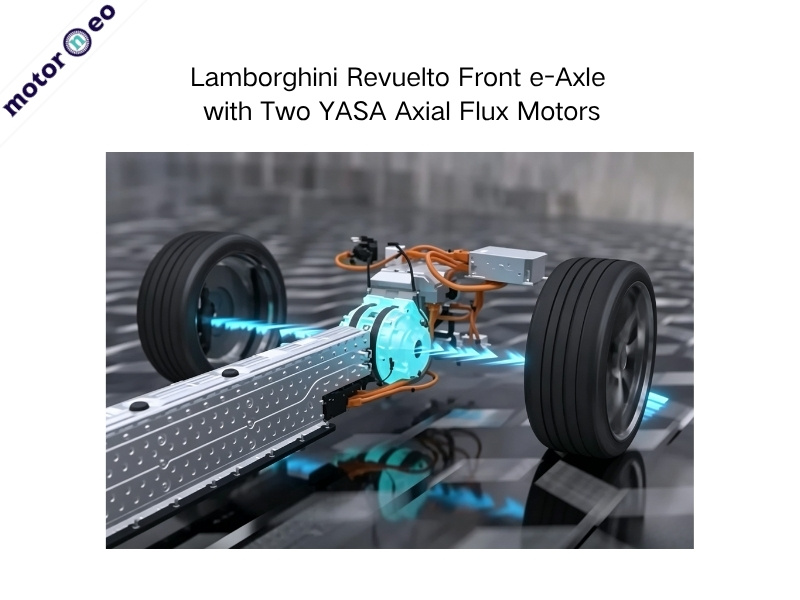
The Lamborghini Revuelto uses two YASA axial flux motors on the front axle.
Each unit provides:
- 110 kW peak power
- 300 N·m peak torque
- 10,000 rpm maximum speed
- 70 mm thickness
The motors also support torque vectoring and regenerative braking.
A 70 mm motor is not simply “small.” It allows Lamborghini to place one electric drive at each front wheel while retaining its V12 hybrid architecture.
Concept AMG GT XX and the Production Mercedes-AMG
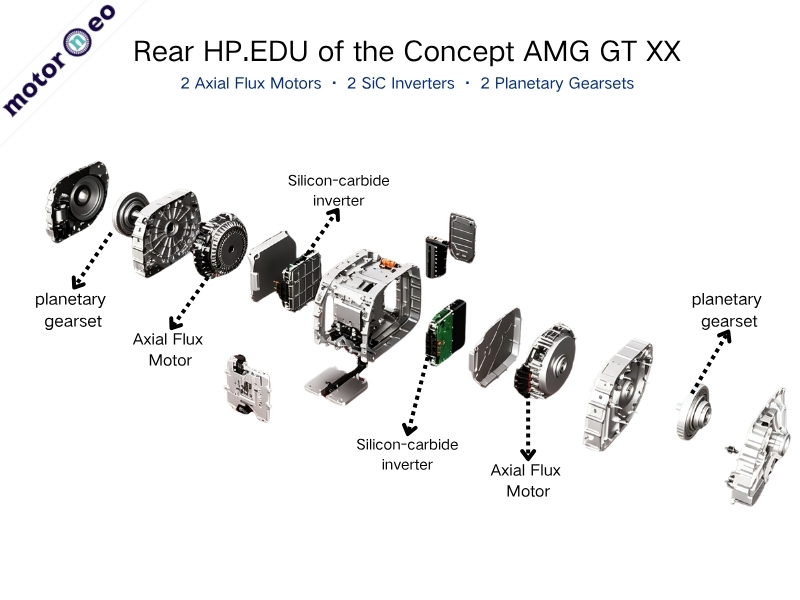
The Concept AMG GT XX pushes the idea further.
Three YASA axial flux motors deliver more than 1,000 kW, or over 1,360 hp, of combined peak output. The two rear motors are each around 8 cm wide.
The production Mercedes-AMG GT 4-Door Coupe keeps similarly compact dimensions. Its front motor measures just under 9 cm, while each rear motor measures around 8 cm. The front axial flux motor also operates above 15,000 rpm.
So the real advantage is not simply:“The motor is thin.”
It is:The motor can deliver very high power while occupying much less axial space.
That is why axial flux motors first gained traction in applications where every kilogram and millimeter matters.
Why Does YASA Use a Segmented Stator?
The segmented stator is another key part of the YASA design.
Instead of using one conventional continuous stator structure, YASA divides the armature into individual magnetic pole units.
This allows the winding to wrap closely around each pole. Shorter winding ends reduce unnecessary copper length.
That has two benefits.
First, less copper can reduce resistance and copper losses. Second, the winding becomes easier to expose directly to cooling oil.
YASA identifies short windings and direct oil cooling as important reasons for its high continuous performance.
The company gives a useful example.
According to YASA, a conventional 200 kW radial motor may sustain only around 80–100 kW under thermal limits. A comparable 200 kW YASA motor can sustain around 150 kW in its example. This is a YASA comparison rather than a universal industry benchmark, but it shows why cooling matters.
However, one point needs emphasis:“Segmented stator” does not describe one universal manufacturing method.
Different axial flux motors may use different magnetic materials, pole structures, supports, winding methods, and assembly processes.
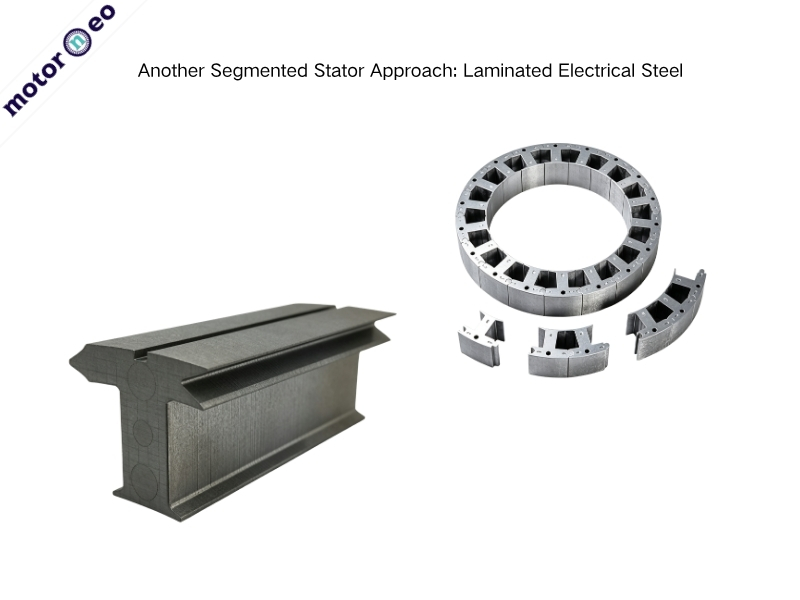
For a manufacturing project, saying only “I need an axial flux stator” is not enough.
A supplier still needs:
- magnetic material
- stator geometry
- segment dimensions
- tolerances
- insulation requirements
- winding specifications
- assembly method
- prototype and production quantity
This is where motor design becomes manufacturing engineering.
The Real Challenge Is Not Thinness, but Stable Manufacturing
Historically, axial flux motors struggled with several practical issues. YASA itself identifies cooling, axial air-gap control, winding complexity, and manufacturability as major barriers to earlier commercialization.
Making one prototype is one problem.
Making thousands with the same air gap, winding quality, insulation, and rotor position is another.
Air Gap and Flatness
The air gap in an axial flux motor extends across a large disc surface.
If the stator tilts slightly, one side of the air gap becomes smaller while the other becomes larger. Flatness and parallelism therefore directly affect magnetic symmetry and mechanical clearance.
Mercedes-Benz provides a striking production example.
During final assembly, the stator enters the space between two magnet-equipped rotor discs. Magnetic forces reach 9 kN, roughly equivalent to a 900 kg load.
At the same time, Mercedes-Benz must hold the stator within 0.1 mm of the magnetic center plane.
The control system even adjusts its position during the final 0.5 seconds of assembly.
This makes “tight tolerance” much more concrete.
The problem is not simply measuring 0.1 mm.
The production system must maintain that position while nearly a tonne-equivalent magnetic force acts on the components.
Windings Are Also a Manufacturing Challenge
Mercedes-Benz uses rectangular copper wire in the stator.
The rectangular section lets engineers fit more copper into limited winding space. However, machines must bend the conductor quickly through tight radii.
They cannot crease the wire, damage its insulation, or reduce its cross-sectional area.
Mercedes-Benz developed a dedicated forming process for this task. It also uses precise laser joining for coil connections in the restricted stator space.
This is an important point for motor manufacturing:
Higher power density usually demands tighter process control.
The motor becomes smaller, but the production challenge does not.
From Prototype to 98 Manufacturing Operations
Mercedes-Benz’s Berlin-Marienfelde production line makes the scale of the challenge visible.
The axial flux motor requires 98 manufacturing operations.
Among them:
- 65 are new to Mercedes-Benz
- 35 are described as new worldwide
- the production technologies generated more than 30 patent applications
- production occupies about 30,000 m²
- the factory uses three halls and seven production lines
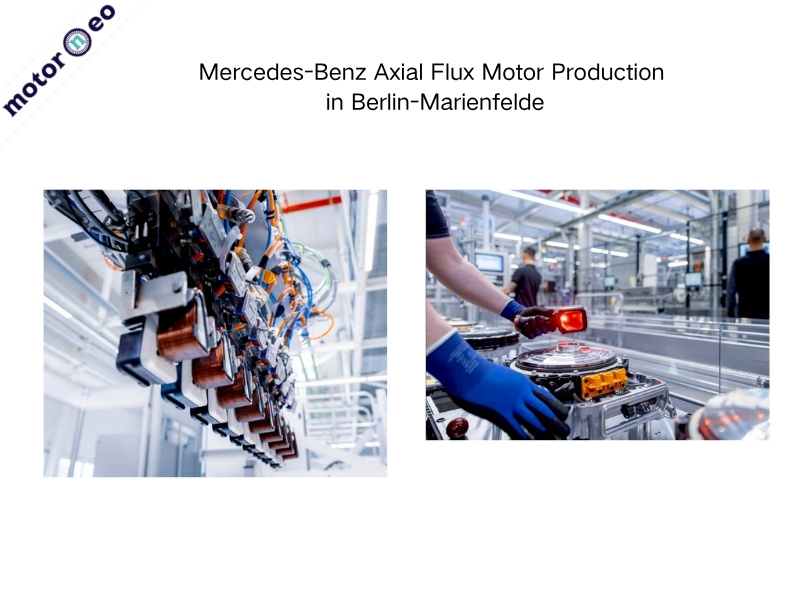
Mercedes-Benz also combines laser processing, automated production, intelligent controls, and AI-supported quality inspection.
These figures are arguably more important than another peak-power record.
They show what industrializing axial flux technology actually requires.
The competition is moving from:
“Can we design a high-performance axial flux motor?”
to:
“Can we manufacture it accurately, quickly, and repeatedly?”
Are Axial Flux Motors Always Better Than Radial Flux Motors?
Radial flux motors still benefit from decades of mature design and production infrastructure.
Axial flux motors become especially attractive when space, weight, torque density, or power density carries a high value.
That explains their early use in Ferrari, Lamborghini, and other performance vehicles. It also explains why Mercedes-Benz’s 2026 production launch matters.
The technology is moving beyond low-volume performance applications and into large-scale automotive manufacturing.
As manufacturing costs fall and production methods mature, will axial flux motors enter mainstream EVs?
Motorneo can manufacture axial flux motor stator and rotor cores based on customer drawings. Contact us if you have a prototype or production project.