
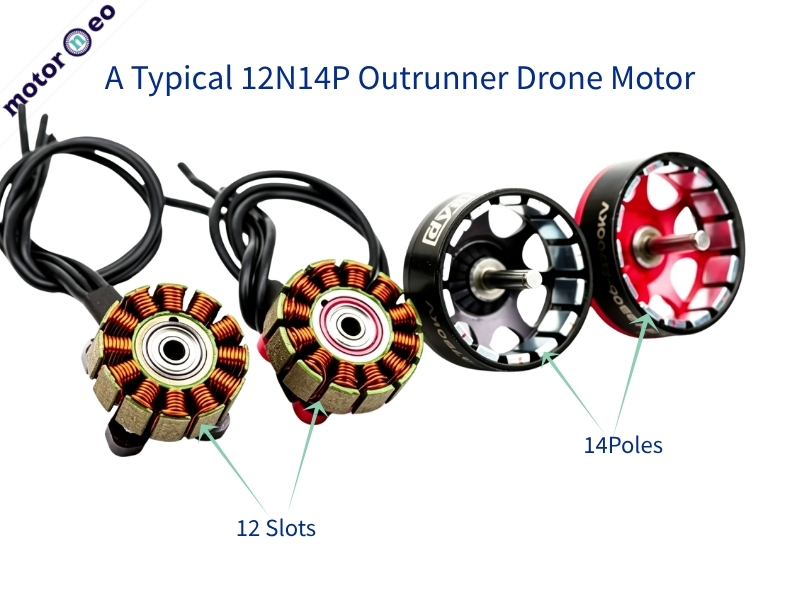
A 12N14P drone motor uses 12 stator slots and 14 rotor poles. This configuration is common in FPV and small-drone outrunner motors. For example, both 925KV and 1155KV versions of the T-Motor VELOX V2812 use 12N14P.
Why 12 slots and 14 poles? It is not the only choice for drone motors. Designers also use other combinations, such as 12N10P and 9N12P. To understand why 12N14P is common, we can examine its structure, winding, outrunner design, and electrical frequency.
What Is a 12N14P Drone Motor?
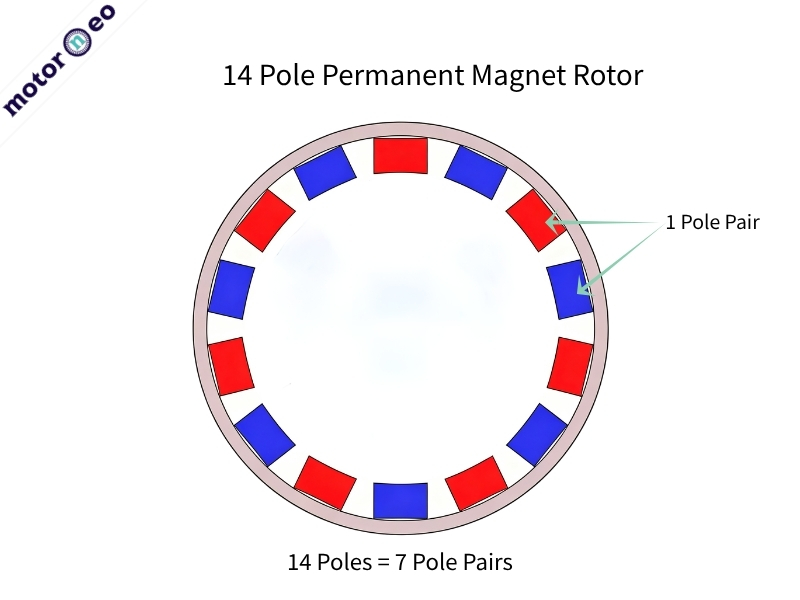
12N means 12 stator slots, while 14P means 14 rotor poles, or seven pole pairs.
In a typical drone outrunner motor, the stator sits inside, with windings around the stator teeth. Fourteen alternating N and S poles line the inner surface of the outer rotor. When energized, the windings create a rotating magnetic field. It interacts with the rotor magnets and drives the outer rotor and propeller.
The slot-pole combination only defines the motor’s basic structure. It does not directly determine motor performance. Even with 12N14P, different turns, wire sizes, magnets, air gaps, stator sizes, and stack heights can change KV, torque, and efficiency.
Why Does 12N14P Work Well with Concentrated Windings?
To understand why 12N14P is common, we also need to look at its winding configuration.
A three-phase 12-slot, 14-pole motor often uses a fractional-slot concentrated winding (FSCW). Its slots per pole per phase are:
q = 12 ÷ (14 × 3) = 2/7 ≈ 0.286
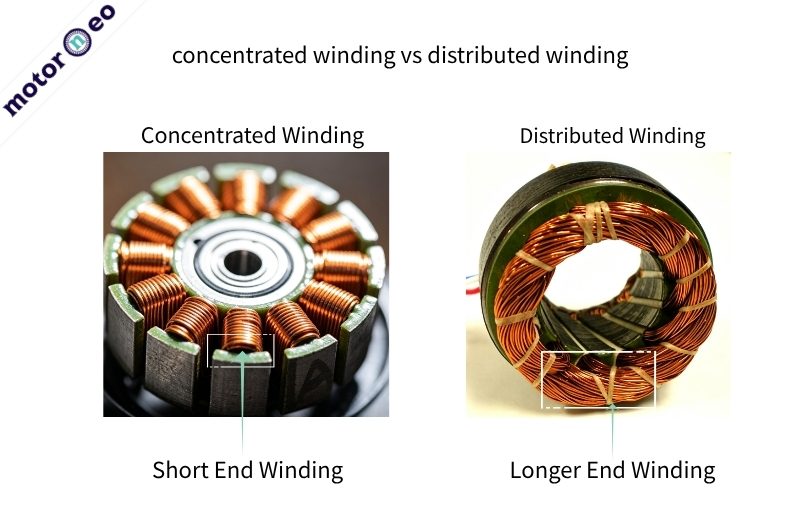
Because the result is not an integer, it is called a fractional-slot winding. Concentrated winding means each coil mainly wraps around one stator tooth instead of spanning several slots.
Why is this structure suitable for drones?
One clear advantage is the short end winding. Copper extending beyond the core ends adds weight and resistance. However, it contributes less directly to electromagnetic conversion than conductors inside the slots. Concentrated windings reduce this inactive copper, helping make the motor more compact and lighter.
For a typical 12-slot, 14-pole single-layer concentrated winding, the fundamental winding factor can reach about 0.933. The exact value depends on the winding layout. Simply put, the winding factor shows how effectively the winding produces the useful fundamental magnetic field.
However, a high winding factor does not guarantee high motor efficiency. Copper loss, iron loss, magnet loss, and heat dissipation still affect actual performance.
Why Does 12N14P Suit Outrunner Drone Motors?
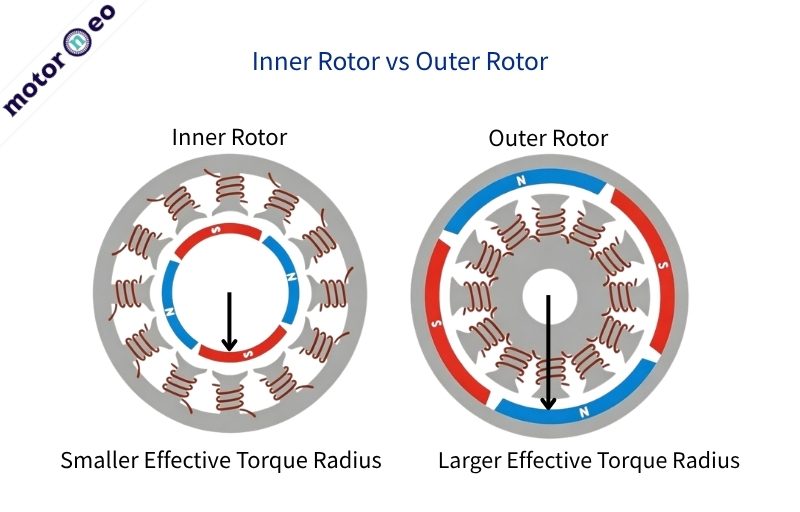
Drone propulsion motors often use an outer-rotor design. Compared with inner-rotor motors, their magnets operate at a larger effective torque radius. Under similar conditions, a larger radius helps produce higher torque. This makes outer-rotor motors well suited for direct-drive drone propellers.
A 12N14P drone motor works well with an outer-rotor layout. A compact 12-slot concentrated-winding stator sits inside. Fourteen magnetic poles are arranged around the outer rotor.
Besides compact structure, cogging torque is another important factor to consider.
When you slowly turn an unpowered brushless motor by hand, the rotor may feel slightly notchy. This comes from periodic magnetic attraction between the permanent magnets and stator teeth.
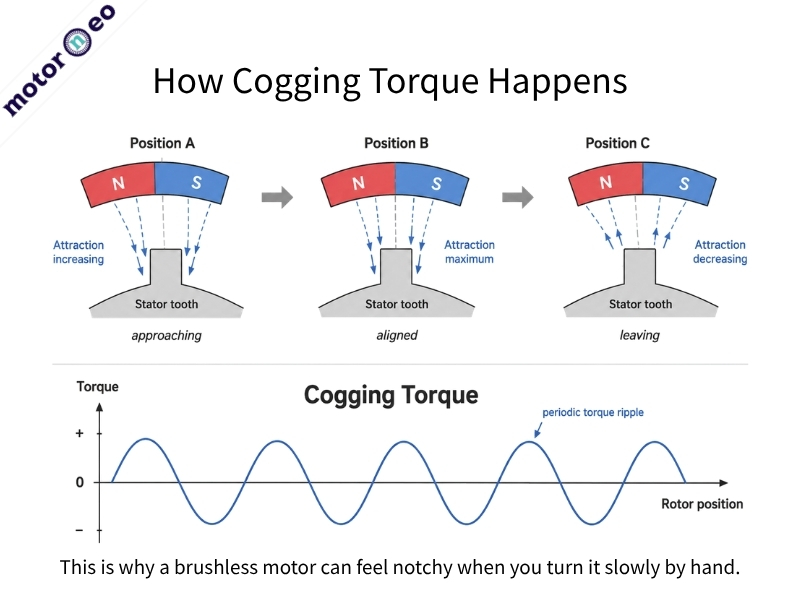
The 12-slot, 14-pole layout does not pair each tooth with one pole. This fractional-slot combination helps optimize cogging torque and torque ripple. However, 12N14P does not always guarantee low cogging torque. Slot opening, pole arc, air gap, eccentricity, and manufacturing accuracy all affect the final result.
Do 14 Poles Have a Downside?
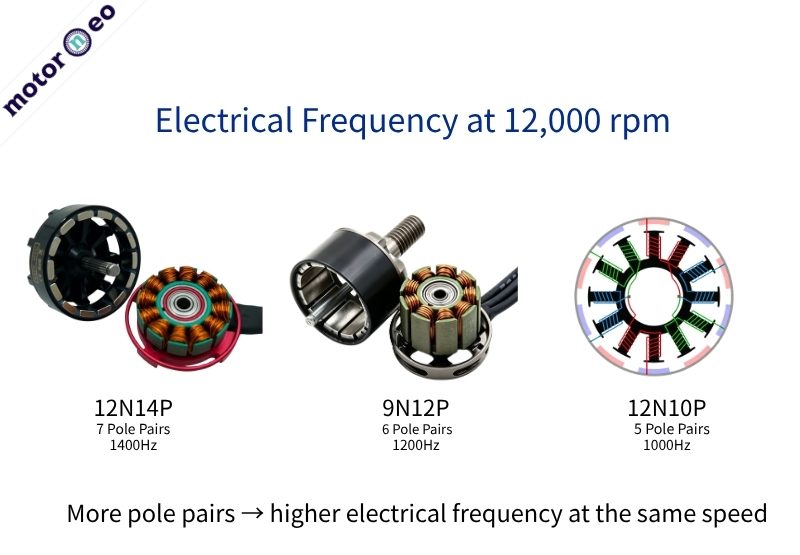
One clear trade-off of using 14 poles is higher electrical frequency at the same mechanical speed.
The calculation is simple:
Electrical frequency = pole pairs × rpm ÷ 60
A 14-pole motor has seven pole pairs. At 12,000 rpm, the calculation is:
7 × 12,000 ÷ 60 = 1,400 Hz
So, at 12,000 rpm, the stator core already sees a fundamental electrical frequency of 1.4 kHz.
esides this fundamental electrical frequency, ESC PWM switching can introduce additional high-frequency flux ripple and core loss.
Why does this matter?
As frequency rises, hysteresis loss, eddy-current loss, and AC winding loss become more important. Designers must consider core material, lamination thickness, and winding design, not only KV and speed.
This is one reason some high-speed, high-power-density drone motors use thinner electrical steel, such as 0.20 mm laminations. Thinner laminations help reduce eddy-current loss, but they make stamping, burr control, and stacking more difficult.
So, 14 poles are not simply “better.” They require a balance between electromagnetic performance and high-frequency losses.
Is 12N14P Better Than 12N10P or 9N12P?
If 12N14P has these advantages, why do not all drone motors use it?
Other slot-pole combinations, such as 12N10P and 9N12P, also have practical value. 12N10P has five pole pairs, so its fundamental electrical frequency is lower at the same mechanical speed. 9N12P uses a different winding layout and stator geometry.
When designing a drone motor, engineers must also consider: Target KV、Speed and torque、Propeller size、Stator diameter and stack height、Winding space、Efficiency and temperature-rise requirements,Different applications require different slot-pole combinations. Therefore, 12N14P is a common solution, not a fixed standard.
The 12N14P drone motor balances compact winding, good torque performance, and a practical outer-rotor layout. However, slot-pole configuration alone cannot determine overall motor performance.
If two 12N14P motors use the same slot-pole configuration, what really makes their performance different?
MotorNeo provides custom motor laminations, stator and rotor cores, and winding services for drone motor projects. We support both prototyping and mass production.