
For the same drone motor, changing only the ESC PWM switching frequency can affect motor noise, temperature rise, and even efficiency.Why? PWM changes the current waveform in the motor windings, which affects magnetic field variations in the stator core.For high-speed, multi-pole drone motors, these additional high-frequency variations may cause higher core loss.
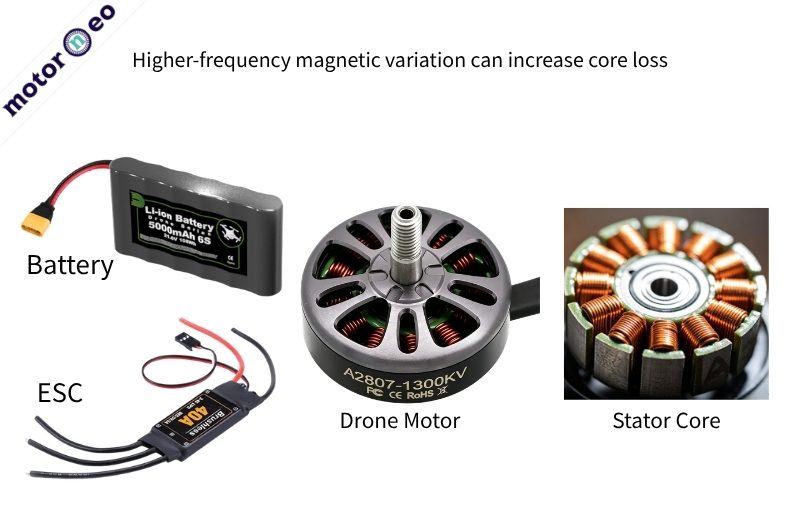
What Is PWM Switching Frequency?
Drone batteries supply DC power, while BLDC or PMSM motors require changing phase currents to generate a rotating magnetic field. ESC uses PWM (Pulse Width Modulation) to rapidly switch power devices on and off, controlling the effective voltage and current.For example, a 24 kHz PWM switching frequency means approximately 24,000 PWM cycles per second.The output is controlled by adjusting the on-time, or duty cycle, of each PWM cycle.
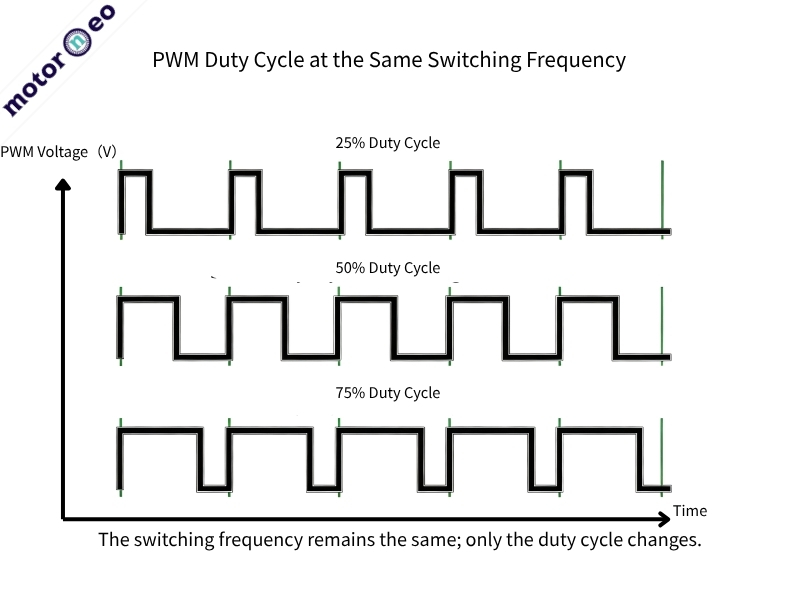
Motor windings have inductance, which smooths some of these pulses, but high-frequency ripple usually remains in the phase current.
Why Are Drone Motors Sensitive to High Frequencies?
Drone motors typically feature high speeds, multiple magnetic poles, compact size, and high power density.
Therefore, their cores already operate at relatively high electrical frequencies.
For example, consider a 14-pole outer-rotor motor running at 12,000 rpm:
Electrical frequency = 7 × 12,000 ÷ 60 = 1,400 Hz
Even without PWM, the main magnetic field in the stator core already undergoes about 1,400 electrical cycles per second.
This is far above the common 50 Hz test condition for electrical steel core loss.
Drone motors are also weight-sensitive, making it difficult to reduce flux density simply by increasing core size.
Therefore, high-frequency losses deserve greater attention.
Electrical Frequency vs. PWM Switching Frequency
The 1,400 Hz above is the motor’s fundamental electrical frequency, mainly determined by speed and pole count. The ESC’s 24 kHz or 48 kHz refers to the PWM switching frequency.
Simply put, electrical frequency sets the pace of the main magnetic field variation. PWM adds smaller, faster variations on top of it. Therefore, the stator core does not experience only a single 1,400 Hz magnetic field during operation.
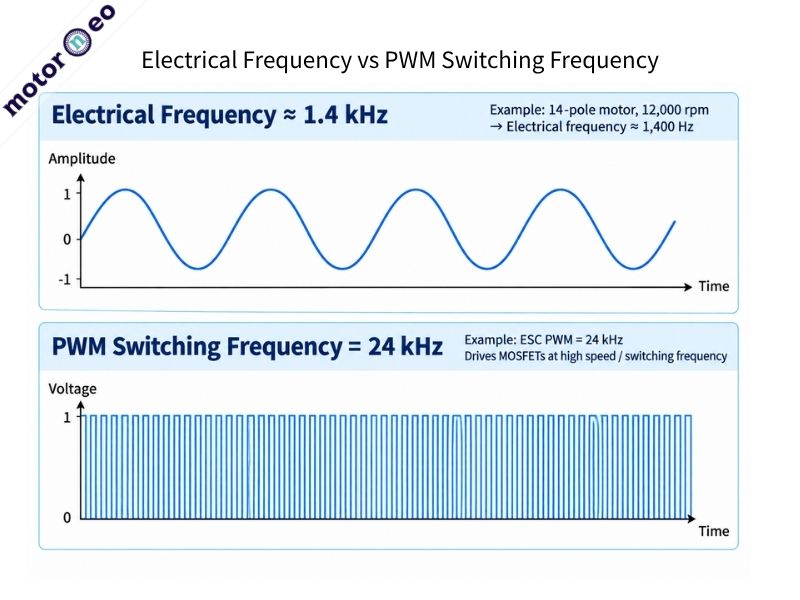
Instead, it experiences:
Main magnetic field + high-frequency flux ripple caused by PWM
How Does PWM Increase Additional Core Loss?
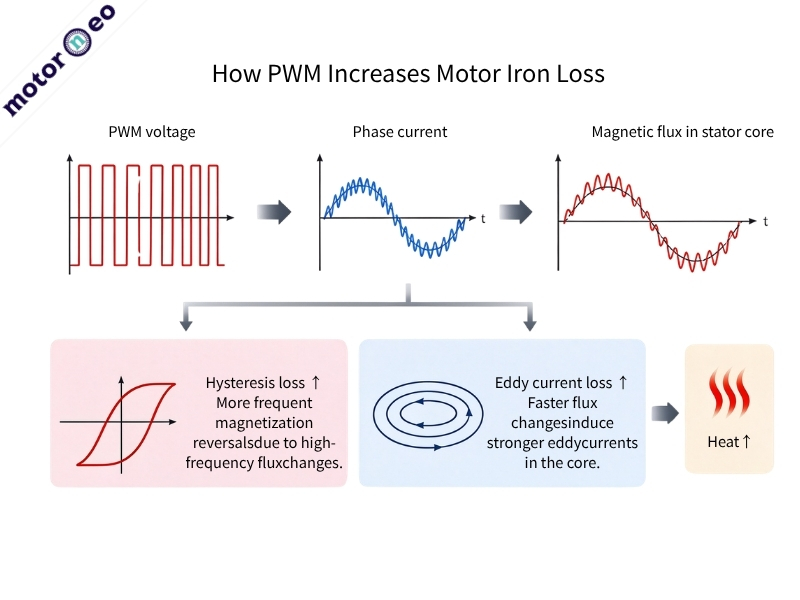
When high-frequency ripple exists in the winding current, the magnetic flux in the stator teeth and yoke also changes rapidly.Think of it like the ocean surface: the fundamental electrical frequency creates large waves, while PWM adds small, fast ripples.These ripples may be small, but their rapid changes can still cause additional hysteresis, eddy-current, and other high-frequency losses.
These losses are especially significant in areas with high local flux density, such as the stator teeth and tooth tips.Ultimately, these losses are converted into heat.
Does Higher PWM Frequency Always Mean Higher Core Loss?
Not necessarily.
For example, increasing PWM from 24 kHz to 48 kHz increases switching events and makes high-frequency effects more pronounced.
The ESC’s switching losses also usually increase.
However, shorter PWM cycles may reduce current ripple in the windings and make the current smoother.
So there is a trade-off: Higher frequency, but potentially lower ripple amplitude.
Final core loss also depends on motor inductance, speed, load, DC bus voltage, modulation method, and core material.
Therefore, doubling PWM from 24 kHz to 48 kHz does not necessarily double motor core loss.
What Does This Mean for Drone Motor Core Design?
First, electrical steel should not be selected based only on P1.5/50.
Core loss at 50 Hz is still useful, but high-frequency performance matters more for drone motors operating above several hundred hertz.
This is especially important when the electrical frequency exceeds 1 kHz. Second, lamination thickness also matters. Drone motors may use 0.35 mm, 0.20 mm, or even 0.10 mm electrical steel.
Thinner laminations shorten eddy-current paths and generally help reduce eddy-current loss at high frequencies.
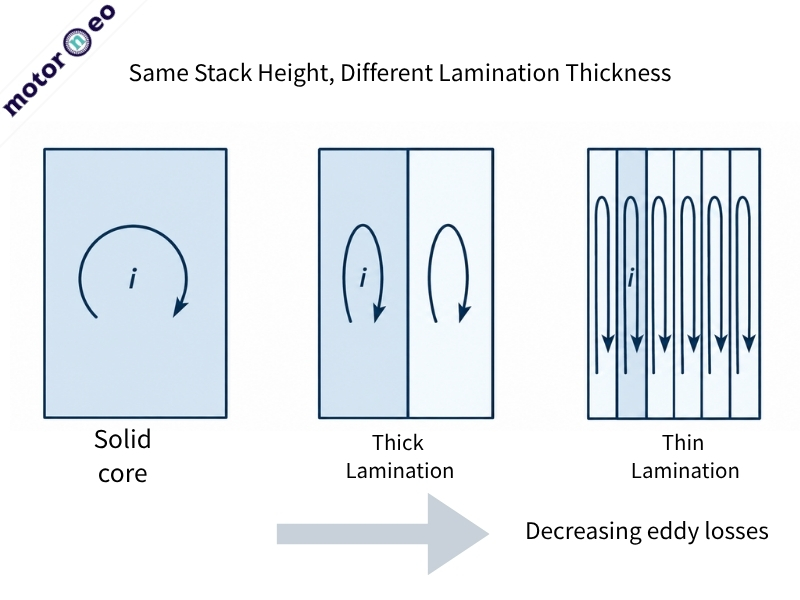
However, thinner is not always better. Thinner laminations mean more layers and greater manufacturing difficulty. They also require tighter control of burrs, alignment, bonding, and stack height. If the operating frequency is not particularly high, the benefits of ultra-thin materials may not offset the additional cost.
Good Materials Still Require Good Core Manufacturing
Even low-loss materials can show higher actual core loss due to burrs, interlaminar shorts, stamping stress, laser heat effects, or misalignment.
In a drone power system:Battery → ESC → Winding Current → Magnetic Flux → Stator CoreSo, when a motor runs too hot, consider not only the ESC settings, but also speed, pole count, PWM frequency, lamination thickness, and high-frequency core loss.
For your drone motor, would you adjust the PWM settings first or check the stator core design?