
Drone motor selection starts with defining the flight mission and maximum takeoff weight. Then calculate the required thrust per rotor and match the propeller, voltage, and motor. Finally, verify continuous operating performance. Focusing only on KV, maximum power, or peak thrust can lead to a propulsion system that takes off but cannot efficiently complete its mission.
This article focuses on multirotor drones. Fixed-wing aircraft rely on their wings to generate lift during cruise. Therefore, the motor selection method for multirotor hovering cannot directly apply to fixed-wing cruise flight.
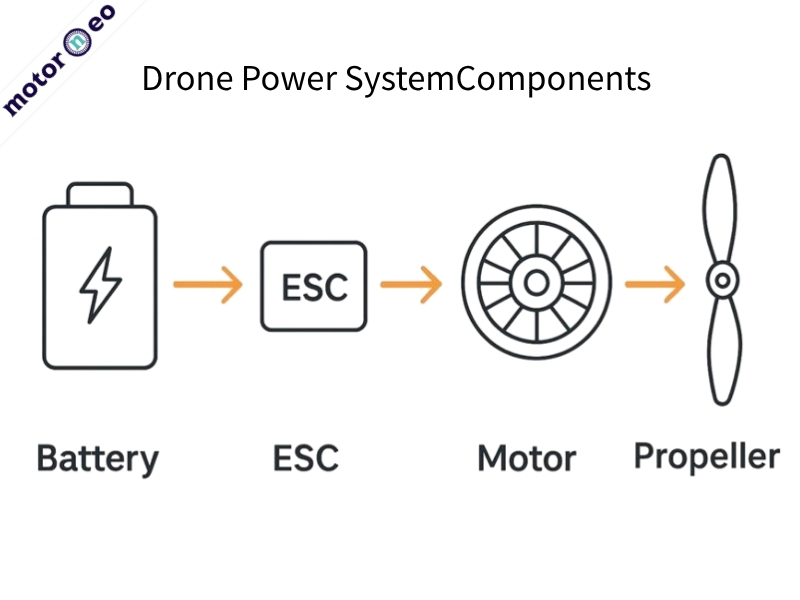
Drone Motor Selection: Start with the Flight Mission
Even with the same 5 kg payload, short-distance transport and long-duration hovering place different demands on the motor. The former requires attention to load changes during takeoff, climbing, and flight. The latter depends more on efficiency and temperature rise at the hovering operating point.
| Flight Mission | Key Motor Selection Considerations |
| Aerial Photography and Stationary Inspection | Hovering efficiency, smooth operation, continuous temperature rise |
| Agricultural Spraying | Full-load takeoff, payload changes, environmental protection |
| Logistics and Delivery | Takeoff and climbing capability, mission energy consumption, power reserve |
| FPV Racing | Transient response, short-term output, rotor inertia |
| Hybrid VTOL | Lift motor operating duration and takeoff/landing cycles |
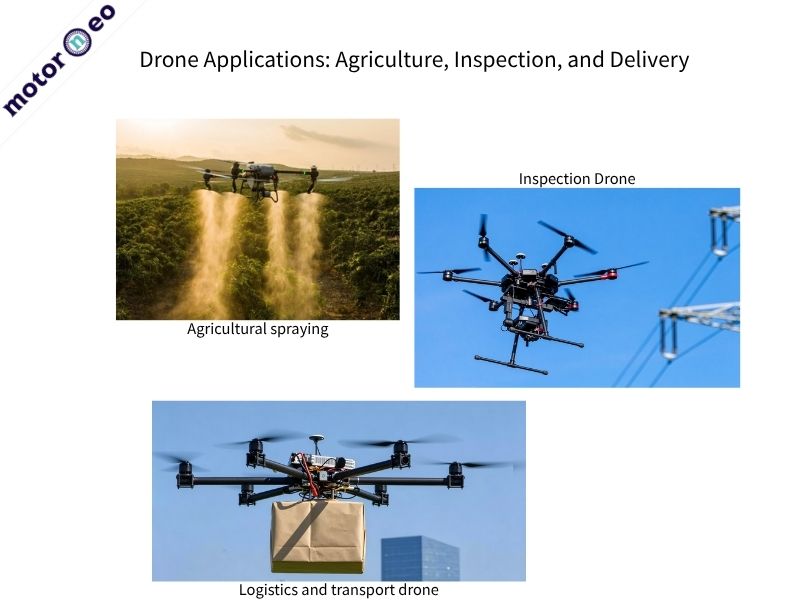
Therefore, before requesting a quotation, clarify the payload weight, flight duration, hovering time, operating altitude, and ambient temperature. For example, inspection drones designed for long-duration hovering should prioritize input power and temperature rise at the required hovering thrust. Delivery drones with frequent takeoffs and landings also need sufficient short-term thrust and power reserve.
Calculate Thrust Based on Total Takeoff Weight, Not Just Payload
The payload is only part of a drone’s total weight. The calculation must also include the frame, battery, motors, ESCs, cables, and mission equipment.
For example, a quadcopter carries a 2 kg payload, while its remaining components weigh 6 kg. Its total takeoff mass is therefore 8 kg. When the drone hovers steadily and horizontally, with all four rotors sharing the thrust equally:
Hover thrust per rotor = 8 ÷ 4 = 2 kgf, approximately 19.6 N.
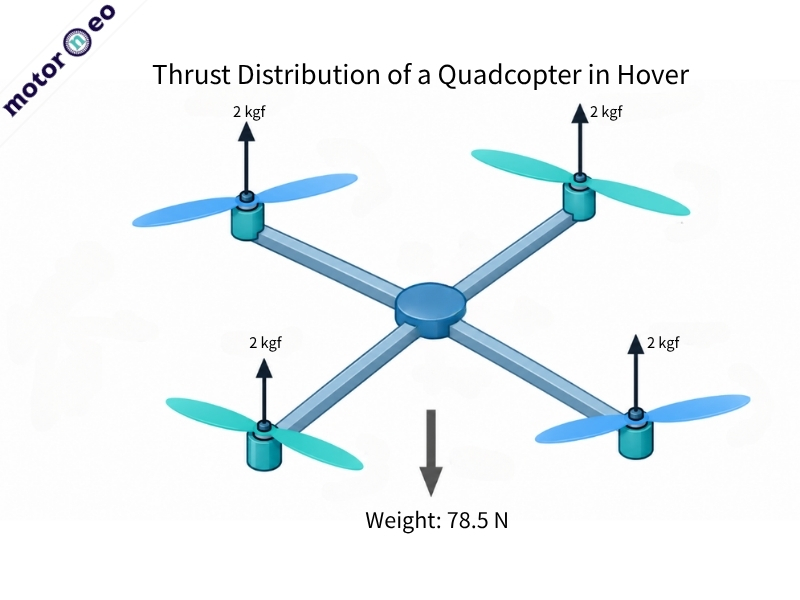
If the preliminary design uses a maximum total static thrust-to-weight ratio of 2:1, each rotor should target 4 kgf. This is only a design assumption for illustration, not a universal standard for all drones. Wind resistance, maneuvering, high-altitude operation, and failure conditions still require separate evaluation.
Note that 4 kgf is the target maximum static thrust, not the thrust the motor must sustain continuously. For this drone, efficiency and temperature rise at the 2 kgf hovering point often have a greater impact on actual flight endurance.
Motor Selection Tip: A heavier battery increases the required thrust, while larger motors add to the drone’s total weight. Therefore, update the weight budget throughout the drone motor selection process.
Have you determined your preliminary propulsion requirements? Share your operating conditions and stator drawings with us. We can evaluate the feasibility of stator winding and manufacturing.
Select the Motor and Propeller Together
The motor provides torque, while the propeller converts mechanical power into thrust. Therefore, when discussing how much thrust a motor can produce, you must also specify the propeller type, voltage, and rotational speed.
First, confirm the maximum propeller diameter allowed by the drone frame. Then check the speed, torque, and power required for each candidate propeller to achieve the target thrust. Next, select a motor that can continuously drive the propeller. When comparing propulsion systems, focus on input power, efficiency, and temperature rise at the same thrust level, not just maximum thrust.
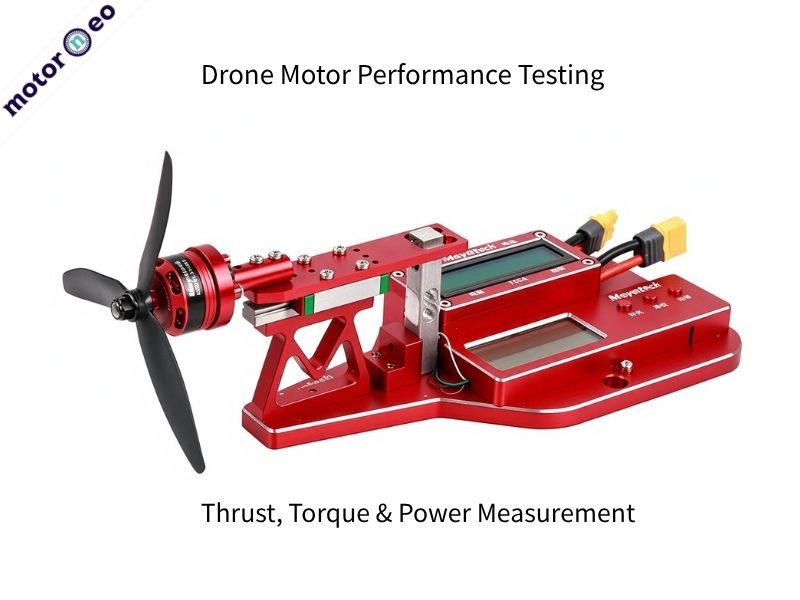
For the 8 kg quadcopter discussed earlier, first compare input power and temperature rise at 2 kgf hover thrust per rotor. Then verify whether each propulsion system can reach the 4 kgf target and how long it can maintain that thrust.
Match Voltage, KV, and ESC: Look Beyond No-Load Speed
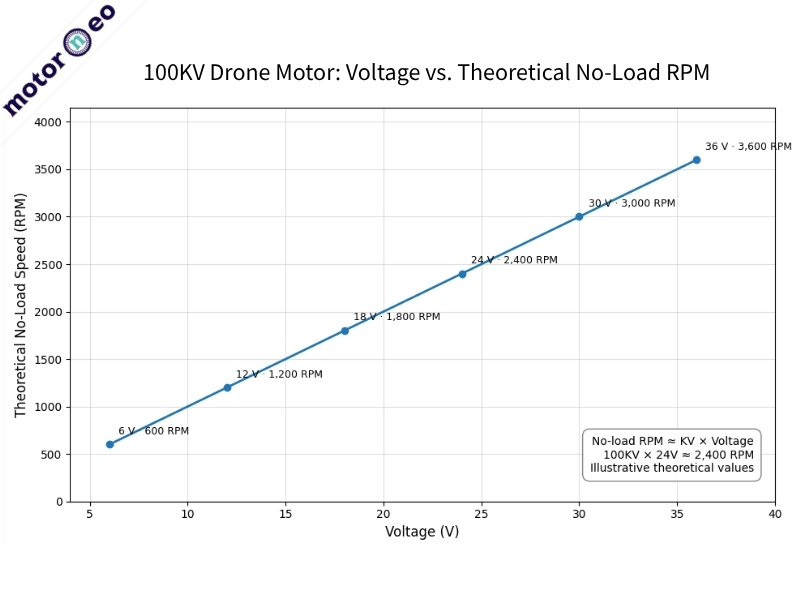
KV indicates the approximate increase in a motor’s no-load speed (RPM) for every 1V increase in voltage. For example, a 100KV motor has a theoretical no-load speed of approximately 2,400 RPM at 24V. After installing a propeller, the actual speed is usually lower due to load, winding resistance, and battery voltage drop.
Once you select the voltage, check motor performance at both full battery voltage and lower voltage under load. Also, verify the ESC’s voltage range, continuous current rating, and cooling conditions. Battery current and motor phase current should not be treated as interchangeable.
Stators of the same size can achieve different KV ratings by adjusting the number of turns, wire diameter, and winding connections. However, you still need to verify winding space, losses, and temperature rise.
Evaluate Continuous Performance, Not Just Peak Power
The ability to produce high thrust for a short period does not mean the motor can sustain it continuously. When selecting a motor, check the duration, ambient temperature, mounting method, and cooling conditions specified in the manufacturer’s test data.
| Items to Check | Evaluation Criteria |
| Hovering Operating Point | Power, current, and temperature rise at the target thrust |
| Maximum Output | Thrust, allowable duration, and temperature limits |
| Mission Cycle | Duration of takeoff, hovering, cruising, and landing |
| Environmental Adaptability | High temperatures, altitude, dust, humidity, and other conditions |
| Dynamic Response | Thrust changes during acceleration and deceleration, and operating stability |
For heavy-lift multirotor drones, peak performance data measured over just a few seconds cannot replace continuous hovering tests. Protective structures can also affect internal heat dissipation.
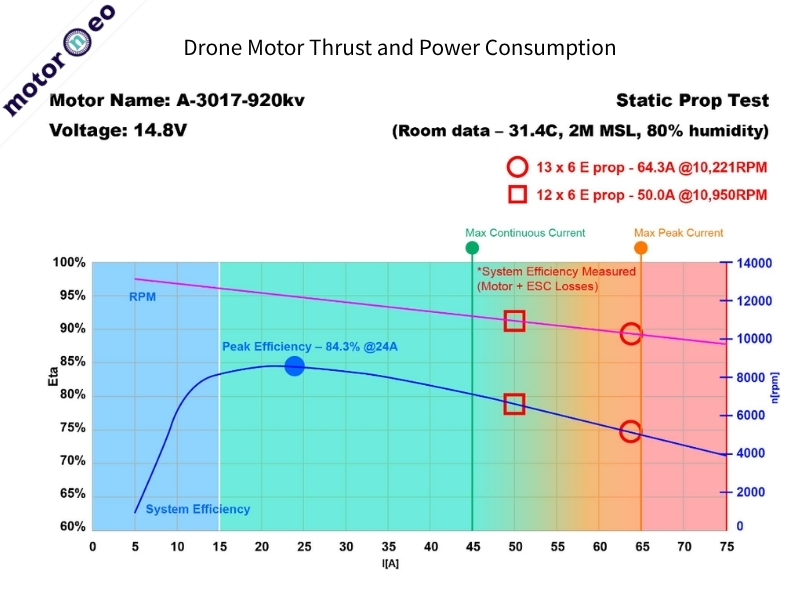
Consider the 8 kg quadcopter discussed earlier. Even if a propulsion system reaches 4 kgf maximum static thrust, it must also sustain 2 kgf hover thrust. If the target flight duration is 30 minutes, a 10- or 30-second peak test alone cannot verify cooling performance. Temperature rise must also be evaluated under representative mission cycles.
Test Performance and Confirm Manufacturing Requirements
Finally, test the planned motor, propeller, ESC, and battery combination. Measure thrust, rotational speed, input power, temperature, and vibration under representative mission cycles. After bench testing, verify airflow and mounting conditions with the system installed on the drone.
If off-the-shelf motors cannot meet the requirements, custom specifications should include target speed, torque, operating duration, and voltage range. They should also cover size and weight limits, stator material, winding, and insulation requirements. During prototype manufacturing, check the stator slot opening dimensions, stack height tolerances, and lamination burrs. Narrow slot openings can make winding more difficult, while burrs may damage the copper wire insulation.
These manufacturing checks are an important part of drone motor selection, especially when moving from design to production.
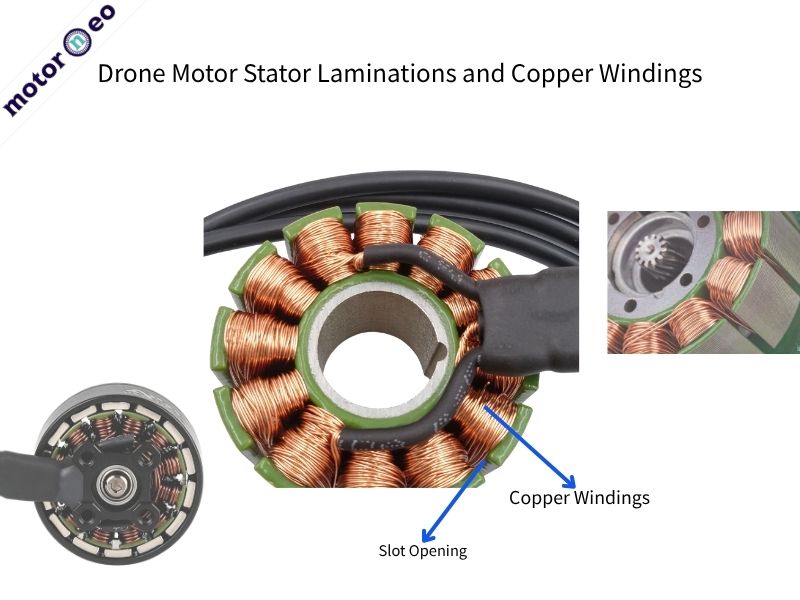
Motorneo can evaluate the manufacturing feasibility of stator laminations, stacked cores, and wound stators based on your drawings. Sharing your flight mission and complete technical requirements helps translate performance targets into manufacturable and inspectable part specifications.
Does your drone need more power reserve for full-load takeoff or greater efficiency during long-duration hovering? The answer may vary significantly depending on the mission. Which factor would you compare first?